Real Estate Information October 31, 2025

Stranded Buyers, Vulnerable Owners: Navigating the Government Shutdown

The longest full government shutdown in U.S. history is delaying sales and could lead to catastrophic risk for homeowners and businesses in flood zones.
U.S. Capitol Building with storm clouds

With the full government shutdown now stretching beyond 30 days, the nation finds itself in unprecedented territory. The effects extend far beyond Washington. Local economies are beginning to feel the strain, and home buyers across the country are seeing slower activity and shaken market confidence. This is now the longest full government shutdown in U.S. history.

Critical housing and mortgage programs are operating at limited capacity, if at all, leaving buyers stranded, sellers waiting and real estate professionals caught in the middle. Many federal agencies that play essential roles in housing are now working with reduced staff or have suspended vital functions entirely.

The National Flood Insurance Program (NFIP) authority to issue new policies has lapsed. While existing policies remain active and transferable, with a 30-day grace period for renewal, uncertainty grows the longer the lapse continues. As the shutdown drags on, many homeowners and businesses that rely on the NFIP could see their coverage expire, leaving families and properties in the highest-risk areas exposed in the middle of hurricane season.

“We’ve never seen a full government shutdown go past 30 days, so it is difficult to know the long-term effects. But we do know there’s a ripple effect that gets worse by the day. The effects on federal housing programs are being felt throughout the country. Our members are reporting it in real time,” says NAR Executive Vice President and Chief Advocacy Officer Shannon McGahn.

“The NFIP cannot issue new flood insurance policies. Delays in FHA and VA loan closings, a complete stoppage of new USDA rural home loans, and increasing uncertainty for affordable housing providers are destabilizing the market and hurting families, home buyers and sellers nationwide,” McGahn says. “We continue to encourage Congress to pass a clean, bipartisan continuing resolution or long-term funding package to reopen the government. Each additional day of uncertainty threatens programs that help buyers, sellers and property owners navigate an already-challenging market.”

Broader Business Coalition Response

NAR’s call to reopen the government is part of a unified push across the business community. This week, a broad cross-section of national business associations—including Airlines for America, the American Bankers Association, the American Hotel & Lodging Association, the Business Roundtable and NAR—issued a joint statement urging Congress to swiftly pass a clean continuing resolution to restore government operations.

“Government shutdowns impose real, escalating costs,” the coalition wrote. “Public estimates of the current funding lapse suggest $10 billion–$15 billion per week in lost output and economic activity. The longer the shutdown persists, the larger and more durable the economic damage becomes—and some of it could never be recovered.”

The statement reflects the recognition across industries that economic stability depends on government stability.

Real-World Impact

As federal workers miss multiple paychecks, short-term cash flow issues grow. Even though back pay is guaranteed, uncertainty can make potential buyers hesitate. NAR Chief Economist Dr. Lawrence Yun indicated that “mortgage rates are trending toward three-year lows, which should further improve affordability, though the government shutdown could temporarily slow home sales activity.” In communities with large numbers of government employees or contractors, listings may stay on the market longer and sellers may begin to adjust expectations.

NAR last week encouraged all 50 state REALTOR® associations to send letters to their senators and representatives urging them to reopen the government and outlining the harmful effects the shutdown is having on the real estate industry in their area. More than 40 state REALTOR® associations have already responded, demanding that Congress do what’s necessary to reopen government reopen and restore stability in the real estate sector.

On Oct. 22, NAR issued a call for information to the full NAR membership. Different from a call for action, in which members click to send a message to their members of Congress, the call for information asks members to write and submit their own stories on the impact they’re experiencing from the government shutdown.

Engagement metrics will be significantly different from a typical one-click CFA.

“Our rapid call for information drew over 600 responses from members sharing firsthand how the shutdown is stalling deals, draining savings and halting closings,” McGahn says.

Each day, there are roughly 2,000 FHA loan closings in the U.S., according to data from 2024. While the shutdown has not affected most of these closings, many FHA borrowers are experiencing disruptions in their homebuying process due to delays in receiving required assistance to address specific circumstances or information needed to close, like federal payoff statements and IRS income verifications. FHA borrowers now looking to buy a condominium can particularly face shutdown-related delays, as only a small percentage of condo buildings are pre-approved for FHA financing and FHA’s process for approving condo buildings and individual units has been suspended during the shutdown. FHA borrowers can check if a condo building is already FHA-approved.

At the same time, roughly 1,000 VA loans close each day. While VA loans should continue to proceed during the shutdown, similar to FHA loans, some borrowers are experiencing delays in closing, particularly active-duty service members who are not receiving pay during the shutdown, which may complicate their ability to close. Additionally, the shutdown may delay the processing of military relocations that are already underway, affecting service members’ ability to complete their home purchases at their new duty stations.

USDA loans, which serve as a vital source of financing in rural communities where conventional lending options may be limited, have been completely paused during the shutdown. While USDA loans represent a smaller portion of the overall mortgage market, their suspension leaves many rural borrowers without viable financing alternatives.

The shutdown may be centered in Washington, but its costs are being paid in communities across America.

Real Estate Information October 23, 2025

Alabama Real Estate Market Update Q4 2025 | ERA King Real Estate

Explore Q4 2025 housing trends in Hoover & Alabaster, AL with ERA King Real Estate. See prices, sales, and inventory insights to guide your next move. #SmartMovesStartHere


Alabama Real Estate Market Update – 4th Quarter 2025

Breaking Down Market Trends, Growth, and What It Means for Buyers & Sellers

As we enter the fourth quarter of 2025, this week’s update takes a detailed look at our market performance through September. Having a deep understanding of these statistics—both for your area and surrounding markets—is essential for every agent and informed homeowner.

These insights will help you communicate confidently with clients, adjust your pricing strategies, and anticipate market shifts.

Let’s dive in!


Key Market Trends That Define Leadership

To help you stay ahead of the curve, we’ve compiled a list of essential market trends every Alabama agent and homeowner should know. The data comes from the Alabama Center for Real Estate (ACRE) and reflects residential sales only.

While other platforms may display slightly different numbers, the overall trends remain consistent statewide. Below, we’ll break down each core metric and highlight what it means for you.


Expanding Across Alabama: Welcome Scottsboro & Guntersville!

We’re thrilled to welcome the Scottsboro and Guntersville markets to our ERA King Real Estate family! 🎉

This morning marks the official ribbon cutting for our new ERA King Scottsboro office, and we couldn’t be more excited. A huge thank you goes out to Donna Marie and her outstanding team for their dedication and leadership in making this launch possible.

Their success reflects what makes our company strong—growth through teamwork, opportunity, and innovation. As we continue to expand, ERA King remains committed to empowering agents and clients across the state.

💡 Learn more about joining our growing ERA King family here →.


Alabama Market Trends & Conditions

1. Average Sold Price / Median Home Price

This indicator reveals how affordable neighborhoods are and helps agents develop accurate pricing strategies.

  • In August 2025, the median home price in Alabama was $271,396, reflecting a 5.2% increase year-over-year.
  • (September 2025 data will be updated soon from ACRE.)

Keeping an eye on these figures helps you guide both buyers and sellers toward informed decisions.


2. Average Sales Price

The average sales price represents the total value of all sales divided by the number of transactions. However, this can be distorted by unusually high or low-priced sales, so it’s best used alongside median price data.


3. Median Sales Price

This figure shows the midpoint of all sales—half sold for more, half for less. It’s less affected by outliers and gives a realistic view of the market’s “typical” home value.


4. Inventory Levels (Homes for Sale)

Inventory directly affects market dynamics:

  • Low inventory = Seller’s Market (rising prices, faster sales)
  • High inventory = Buyer’s Market (more choices, stronger negotiations)

In August 2025, Alabama reported 23,083 homes for sale, a 10.2% increase year-over-year, signaling more opportunities for buyers entering the market.


5. Homes Sold (Market Activity)

This metric highlights demand strength across the state.

  • In August 2025, 5,426 homes were sold statewide, a 2.5% increase year-over-year.

A higher number of sales reflects steady buyer confidence and healthy market movement.


6. Months of Inventory (MOI)

MOI measures how long it would take to sell all current homes if no new listings entered the market.

  • Six months typically signals a balanced market.
  • In August 2025, Alabama averaged 4.3 months of inventory, up 7.5% year-over-year—a slight shift toward balance after several years of low supply.

7. Days on Market (DOM)

DOM shows how long homes stay listed before selling.

  • In August 2025, the average DOM statewide was 71 days, up 33.2% year-over-year.

While this increase may seem significant, it suggests a healthier, more balanced market, allowing buyers time to make confident decisions.


September 2025 Market Insights by Region

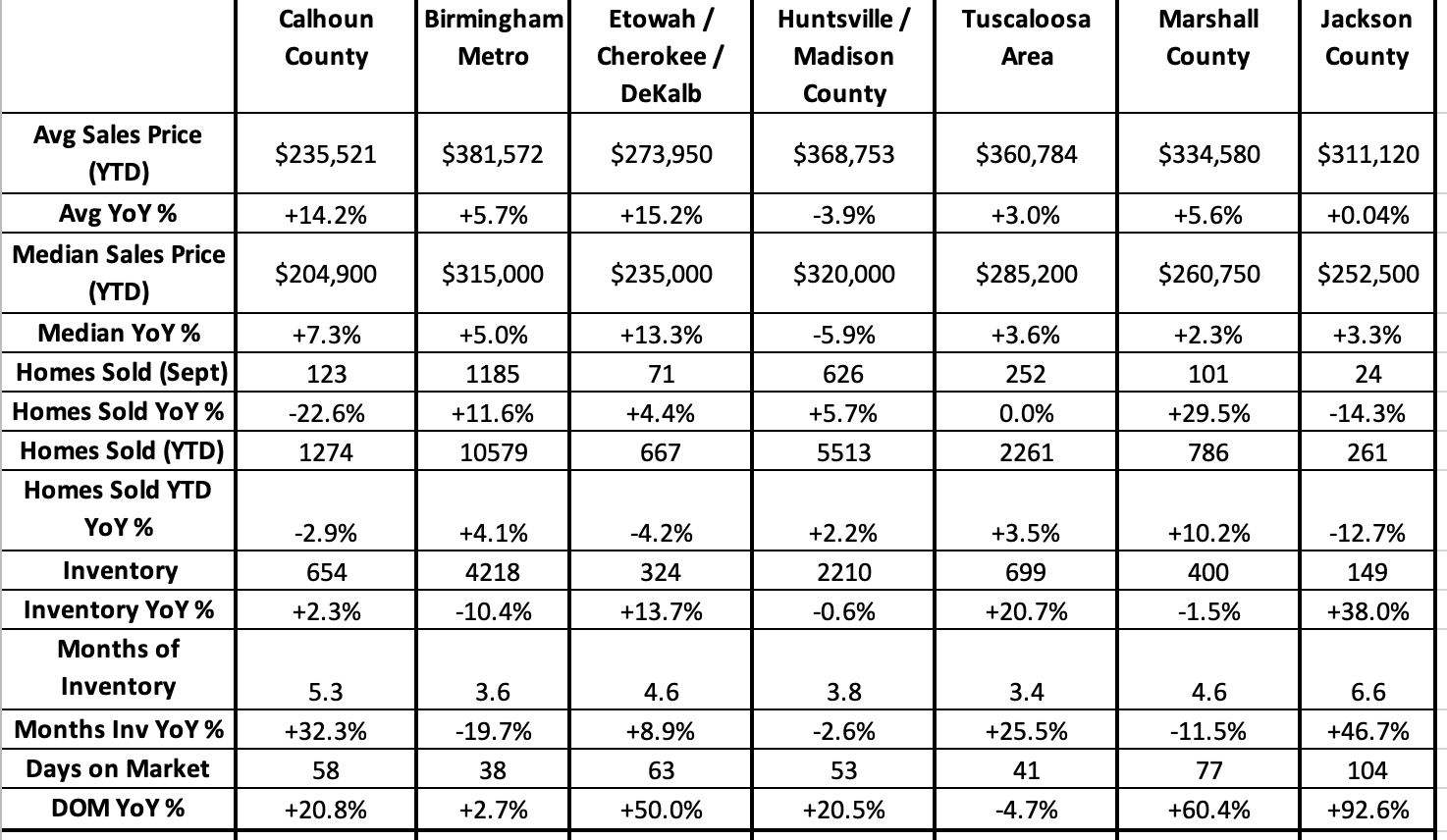
Here’s a snapshot of key Alabama markets for September 2025, including year-over-year comparisons.

The Birmingham Metro region—covering Jefferson, St. Clair, Shelby, Blount, and Bibb Counties—continues to lead the state in sales activity and price growth.

Other markets like Hoover and Alabaster show steady appreciation and strong buyer demand, particularly in mid-priced home categories.

📊 Explore neighborhood-level data and listings for Hoover → or Alabaster →.


Final Thoughts: Position Yourself for Success in Q4 2025

As we move deeper into the final quarter of 2025, understanding these market dynamics will help you:
✅ Advise clients confidently
✅ Develop sharper pricing and marketing strategies
✅ Identify upcoming opportunities before competitors do

At ERA King Real Estate, we’re proud to provide the tools, data, and leadership that help our agents and clients make #SmartMovesStartHere.

🏠 Ready to take your next smart move? Connect with an ERA King agent here →.


Would you like me to also create a featured image caption + alt text (optimized for SEO) for when you post this on your website or blog? It helps Google index the page better and can boost clicks from image search.

Play
Uncategorized October 16, 2025

Govt Shutdown and what it means for you.

Welcome to this week’s Jason’s Information Drop!  We are now on day 15 of the shutdown and I know many of you have received questions and concerns from your clients about how it could impact their home buying or selling process. This week I would like to cover the continuing effects this shutdown is having on our industry and provide you with the latest information to effectively address your clients’ concerns. Let’s dive in…
As expected, the Senate failed to advance the funding bill Tuesday afternoon, and the government remains shutdown. At 15 days and counting, this is now the fourth-longest U.S. federal government shutdown in history. The longest government closure in our history came in 2018-2019 and was over the U.S./Mexico border wall debate. The current issue is centered on a disagreement over Affordable Care Act subsidies and other health care policy issues.
The most common question right now is, “How long will this last?” Unfortunately, there is no definitive answer. The current political standoff shows neither side willing to make concessions, leading many analysts to believe the shutdown will last for at least a couple more weeks. Many believe the next deadline for a resolution isn’t until the end of the month. For historical context, the second-longest shutdown in U.S. history lasted 21 days back in 1995.
While our industry feels the slowdown, many federal workers are already facing severe financial hardship. If your client is a government employee, they are likely furloughed or working without pay, which is currently affecting hundreds of thousands of people. Even though furloughed employees are guaranteed back pay once the government reopens, the current uncertainty makes underwriters reluctant to approve their loans to close. Although military pay is currently secured, that funding is not guaranteed if the shutdown extends into the next month. It is extremely important that you ask the right questions and work closely with your clients and their lenders to navigate the immediate risk this poses to their loan closing timeline.
The Real Estate Impact: What Your Clients Need to Know
The primary impact on the housing market is slowdowns and pauses in processing due to reduced or suspended operations at key federal agencies. This affects closings and loan approvals, especially for government-backed programs. Below is a quick reference guide on loans we deal with on a daily basis and how they are currently being impacted by the government shutdown:
Government Shutdown Impact on Home Loans: Quick Reference
Important Note for All Closings
Even conventional loans may be delayed if the property is in a FEMA-designated flood zone, as the National Flood Insurance Program cannot issue or renew policies during the shutdown. Existing policies remain valid, but transactions requiring new or renewed coverage may stall. An alternative option for your clients may be to secure a private flood insurance policy to meet their lender’s requirements and avoid closing delays, as the private market is not affected by the government shutdown. Lenders are permitted to accept private flood insurance, but you should confirm their specific requirements with the loan officer.
What can you do as an agent to get in front of potential issues during the shutdown:
  • Communicate: Proactively communicate with clients and lenders about potential delays.
  • Plan: Build extra buffer time into all closing timelines, especially for FHA and VA loans. New USDA loans are currently paused and most in process are halted.
  • Verify: Ensure all non-federal documentation is gathered promptly (W-2s, pay stubs, bank statements, etc.) to minimize holdups.
My hope is that this newsletter is irrelevant by next week and the government shutdown is quickly resolved! However, just in case it isn’t, I hope this helps you in handling your client’s questions. On a separate note, I want to extend a massive thank you to everyone who made it to our company-wide rally yesterday. The speakers and panel were fantastic, and the positive feedback has been overwhelming. Seeing your dedication to continuous training is what makes ERA King exceptional.